
Beyond Decor: The Definitive Guide to Acquiring Masterpiece Rugs.


In the world of high-end interior design, few elements command the room quite like a hand-woven rug. To view these pieces merely as "floor coverings" is a misunderstanding of their nature. A true hand-knotted carpet is a textile document a piece of history, a work of art, and, crucially, a tangible asset.
For the discerning collector or the homeowner curating a legacy estate, the acquisition of such a piece requires a shift in perspective. You are not simply decorating a room; you are anchoring it.
Here is what defines a masterpiece, and how to approach the acquisition process with the eye of a curator.
1. The Hierarchy of Material: It Begins with the Fiber
When we curate pieces for our private collection, the first inspection is always tactile. The longevity and luster of a rug are dictated entirely by the quality of its ingredients.
-
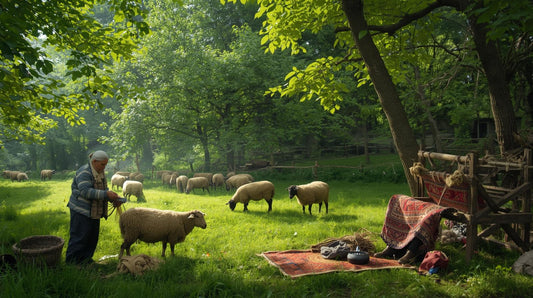
Live Wool (The Gold Standard): We advise clients to look for "live wool"—sheared from healthy, living sheep. This wool retains its natural lanolin, giving the rug a velvety sheen and inherent stain resistance that chemical washes can never replicate.
-
The Silk Premium: For formal drawing rooms or master suites, silk is unrivaled. It offers a refractive quality, changing colors as the light moves across the room. However, true investment-grade silk requires an expert eye to distinguish it from mercerized cotton blends—a distinction we guarantee with every piece we present.
2. Provenance and the "Perfect Imperfection"
In luxury production, we are often taught to look for uniformity. In the world of hand-woven rugs, we look for humanity.
-
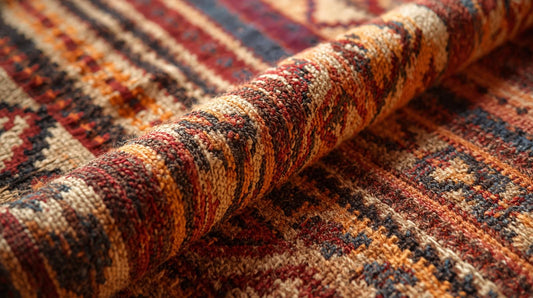
Abrash: You may notice subtle bands of color variation in a high-quality rug. This is called Abrash. It indicates that the wool was dyed in small, artisanal batches using natural vegetable dyes, rather than mass-produced chemical synthetics. It is a hallmark of authenticity.
-
The Knot Count: While Knots Per Square Inch (KPSI) is a metric of fineness, it is not the only metric of beauty. A tribal rug with a lower knot count can be just as valuable as a fine city rug if the design execution and wool quality are superior.
Our Promise: Every rug in our gallery is hand-selected for its authenticity. We don't just sell a pattern; we provide the provenance behind the weave.
3. Architecture and Scale: The Foundation of the Room
One of the most common errors in luxury design is "floating"—choosing a rug that is too small for the grandeur of the space.
-
The Anchor Principle: In a grand living space, the rug should act as the foundation. Ideally, all furniture legs should sit comfortably within the rug's borders. This creates a "room within a room," offering intimacy within vast architecture.
-
Custom Commissioning: Sometimes, the room dictates the rug. For estates with non-standard dimensions, we offer bespoke sourcing services. We work with master ateliers to find or commission pieces that fit the exact geometry of your architectural vision.
4. The Investment Value: An Asset Underfoot
Unlike modern furniture which depreciates the moment it leaves the showroom, a high-quality hand-woven rug is a portable asset. Antique and semi-antique rugs (aged 50-100+ years) have historically appreciated in value.
However, this value depends entirely on condition and care.
-
Expert Maintenance: Preserving the value of a masterpiece requires more than a vacuum. It requires professional, organic cleaning and rotation. We view our relationship with clients as a long-term partnership, offering the specialized care these assets require to remain heirlooms for the next generation.
5. Trusting the Curator's Eye
The market is flooded with machine-made reproductions masquerading as hand-knotted art. The difference is often invisible to the untrained eye but glaringly obvious in the longevity of the piece.
We verify the origin, the era, and the technique of every knot.
The Next Step
Your home deserves a soul, not just a surface.
Invest in Legacy. Visit our showroom or contact us for an appraisal.

No comments


0 comments